02 / LEAH — INDEPENDENT PRODUCT
A clearer day.
For both of us.
A baby-care log built to help two tired parents pick up where the other left off—without remembering every detail.
Try the interaction ↓BUILT AROUND A VERY HUMAN QUESTION
“When was the last feed?
And how much did she drink?”
01 / THE PROBLEM
The days became a loop.
The details got lost.
Feed. Change. Settle.
Try to sleep.
Start again.
At home with our baby, my wife and I found ourselves repeating the same cycle. Small details were hard to recall: when the last feed happened, how many millilitres were consumed, and what had happened while the other parent was resting.
The apps I tried presented more information than I needed for everyday care. I wanted a clear view of what had happened, without having to reconstruct the day from memory.
And it had to work for both of us. A log that only helped me remember would still leave my wife asking the same questions.
How might we help two tired parents understand recent care and record the next activity with as little effort as possible?
02 / FIRSTHAND DISCOVERY
Start with the day
we were actually living.
One household.
A concrete need.
A focused starting point.
Discovery began with personal observation and the needs my wife and I encountered. This was not a formal interview study. My experience with other apps helped frame the opportunity, rather than serving as a systematic competitive benchmark.
Three needs guided the first version. Whether they apply to other families is a question for the next research round.
Remember the details.
Make timing and milk volume easy to record and find, even when the day feels repetitive.
Share the context.
Give either parent access to the same care history when taking over.
Keep the day clear.
Prioritise recent care and the next action without putting every feature on the first screen.
03 / DESIGNING THE EXPERIENCE
Understand the present.
Record what happened.
Current activity and Quick Log.
A chronological care record.
Longer-view information and shared access in their own spaces.
EXPLORE A CORE INTERACTION
Try it yourself.
From feed to shared history.
Tap the highlighted controls on the actual app screens, or choose a step below. Follow a 120 ml feed from Quick Log to confirmation, then see it in the day’s timeline and explore the longer view.
Start by tapping Feed on the screen.
A clickable walkthrough using actual Leah screenshots. Highlighted controls move between screens; fields aren’t editable and no care records are saved.
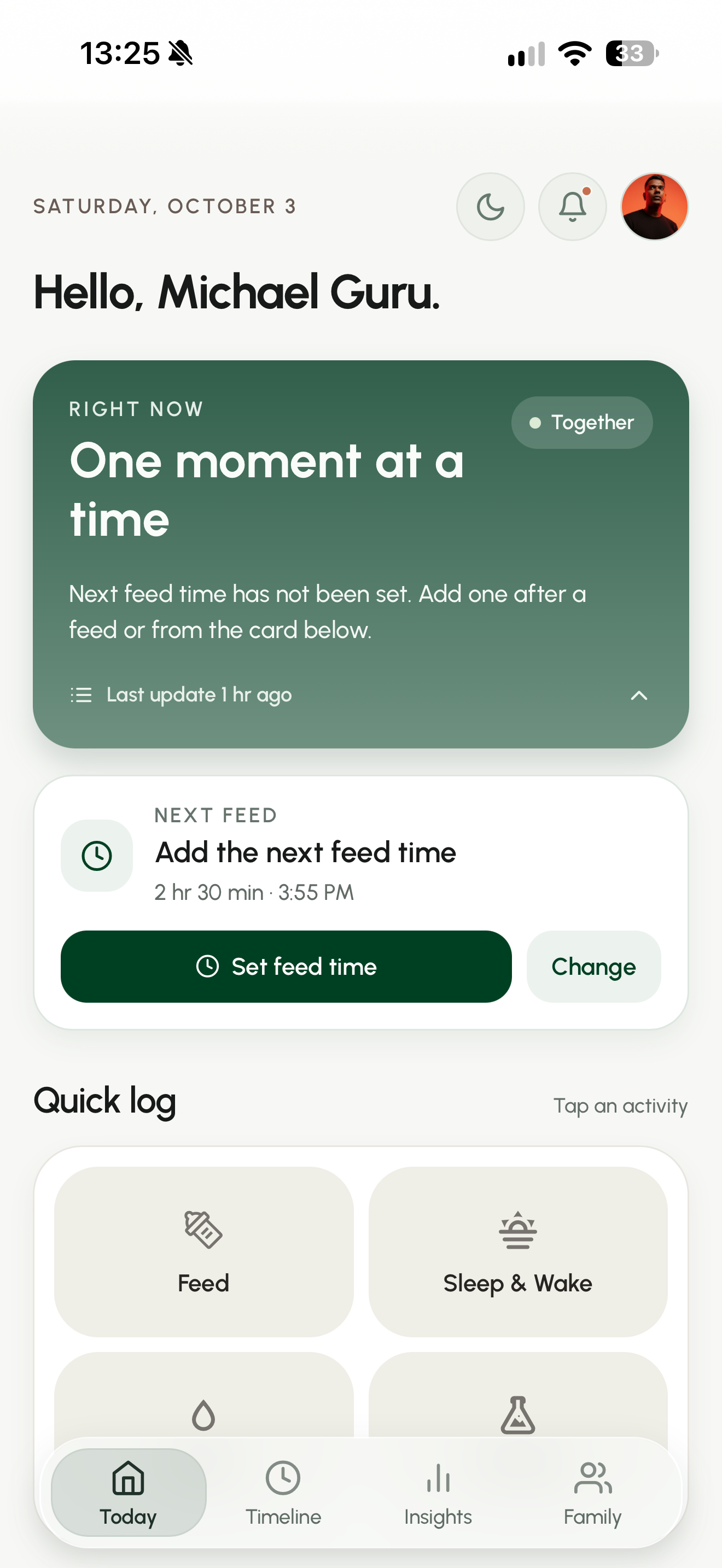
Keep active care within reach.
The Right Now card provides a consistent home for an active feeding, sleep, or pumping session. Its expanded view preserves timer controls and context when a parent is interrupted.
Make the record shared.
Authenticated family membership and invitations let both parents use the same history. Creator attribution shows who logged an activity. The documented beta updates through refresh and app-focus refresh.
Make uncertainty visible.
Queued and failed states communicate when an entry has not reached the server. Retry behaviour helps protect the record when the connection is interrupted.
04 / FROM DESIGN TO WORKING PRODUCT
AI helped me build.
The problem set the direction.
Design judgment continues
after the screen looks right.
I used AI-assisted development to translate the experience into an executable product. I defined the problem, directed the experience, and guided implementation around our household’s needs.
The work covered activity entry, timers, family access, timeline editing, offline recovery, and reusable interface patterns. Working in code exposed states a polished screen alone could not resolve.
What deserved attention?
I prioritised recent care, timing, amounts, and shared history. The aim was a calmer everyday experience, not the largest possible set of features.
Make the experience executable.
AI supported implementation and test work across the mobile interface, data flows, shared access, and recovery behaviour.
Resolve the less visible states.
Decisions around late entries, save feedback, duplicate prevention, and the second parent’s view were central to whether the product could be trusted.
ONE IMPLEMENTATION DECISION, ONE HUMAN NEED
An interrupted connection
shouldn’t become another thing to remember.
New care events enter a durable local queue before the network write. Retries reuse the same event identity to avoid duplicates. This connects implementation directly to the design goal: parents should not need to reconstruct and re-enter a lost activity.
A CONSISTENT VISUAL LANGUAGE
Calm enough to scan.
Consistent enough to learn.
The design system uses brand green for primary actions and distinct activity colours for feeding, sleep, diapers, and pumping. Labels carry meaning alongside colour.
Readable functional text, generous spacing, and shared controls support scanning. Light and dark themes retain the same structure, so changing appearance does not mean relearning the interface.
These are design foundations, not a claim of a completed accessibility audit.
05 / VALIDATION
Test the moments
when things go wrong.
One offline entry.
Two parents.
No duplicate in the recorded test.
A physical-device test recorded on 25 September 2026 checked a wet-diaper entry through an interrupted connection. The user-confirmed result covered the full sequence below.
Realtime subscriptions remained disabled. The second parent saw the entry after refreshing.
- 01 / OFFLINE
Log the activity.
The entry remained visible with a pending state.
- 02 / REOPEN
Close and restart.
The queued entry survived the app restart.
- 03 / RECONNECT
Refresh the record.
Exactly one cloud event was produced.
- 04 / SHARE
Check the other parent.
The second authenticated parent saw the same event after refresh.
What the evidence supports
A working shared-care flow and a documented offline recovery scenario. Historical automated checks also covered family isolation, queue recovery, duplicate prevention, and ordering with 750 fixture events.
What still needs research
Whether other parents log faster, recall fewer details incorrectly, or find handovers easier. Functional checks do not establish those usability outcomes.
06 / OUTCOME & REFLECTION
From a personal need
to a functioning product.
Clarity is what people see.
Reliability is what lets
them depend on it.
Leah demonstrates how I connect product thinking and interface design with implementation. The outcome is a working application with implemented shared-care behaviours and documented testing—not a measured claim of reduced parent workload.
Building it made the connection tangible: a clear timestamp matters, and so does whether that record survives a dropped connection and reaches the other parent.